
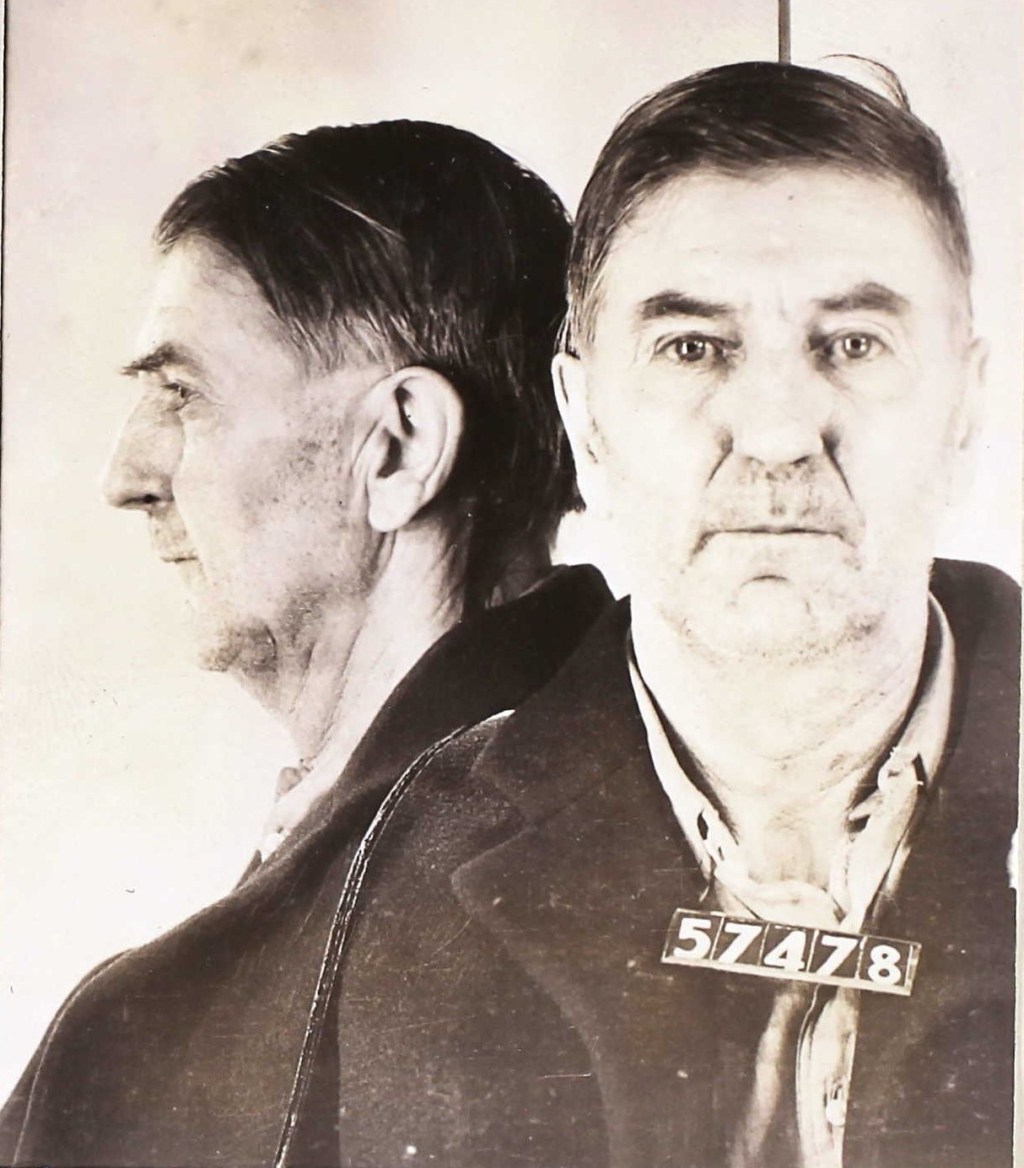
Today we are going to explore (as much as historical newspapers and such will tell us) the extreme ending to a neighborly feud April 27, 1934.
Just South of State Route 1, a group of cottages stood at 1732 and 1740 Molino Avenue in the Whittier neighborhood of Long Beach, California.
One cottage was occupied by Jasper Dayton Richards, a miner by trade. Jasper was born on April 5, 1874, in Chautauqua County, Kansas to Elias Robert (1834-1880) and Martha Mahala (Hobbs) (1840-1929) Richards. They had 9 children, 4 daughters and 5 sons all told. The 1875 Kansas state census places the Richards family in Wyandotte Township, Wyandotte County, Kansas. Elias worked as a farmer and wagonmaker until he died of “typhus malarial fever” (per the 1880 U.S. federal census taken earlier that year, Elias also suffered from consumption) on October 23, 1880, at the age of 46 in Bloomfield, Davis County, Iowa.
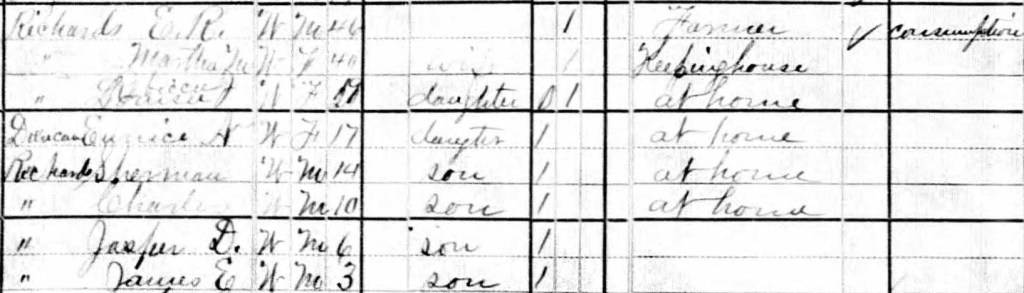
The Richards Family on the 1880 U.S. Federal Census
By the time that Elias shuffled off this mortal coil, two of their daughters had married and moved away to start their own families and two had died young. Martha raised the remaining 5 children on her own and it’s hard to imagine how difficult that was for all of the family. Due to the awful events that caused the 1890 federal census to disappear forever, the next time we get a glimpse of the Richards family is on the 1900 federal census. At that time, they were living in Cherokee County, Kansas. The household had shrunk again, this time to Martha and 4 children. Mom took care of the house and the four remaining boys worked as coal miners. There is a marriage record for a Jasper D. Richards and Annie Hunter in Carthage, Jasper County, Missouri in 1906, which is not far from Pittsburg, Kansas (About 40 miles.). While it may be the same Jasper, it cannot be completely verified because only the name checks out. (By 1920, he is listed in the U.S. federal census as “Single.”) The 1915 Kansas state census places the Richards household (now consisting of Martha and 3 of her sons, Sherman, Jasper, and E.C.) in Pittsburg, Crawford County, Kansas. In 1918, a 44-year-old Jasper registered for WWI in Aberdeen, Grays Harbor County, Washington. He was working as a ship carpenter for the Grays Harbor Motorship Company and listed his nearest relative as his mother in Pittsburg, Kansas.
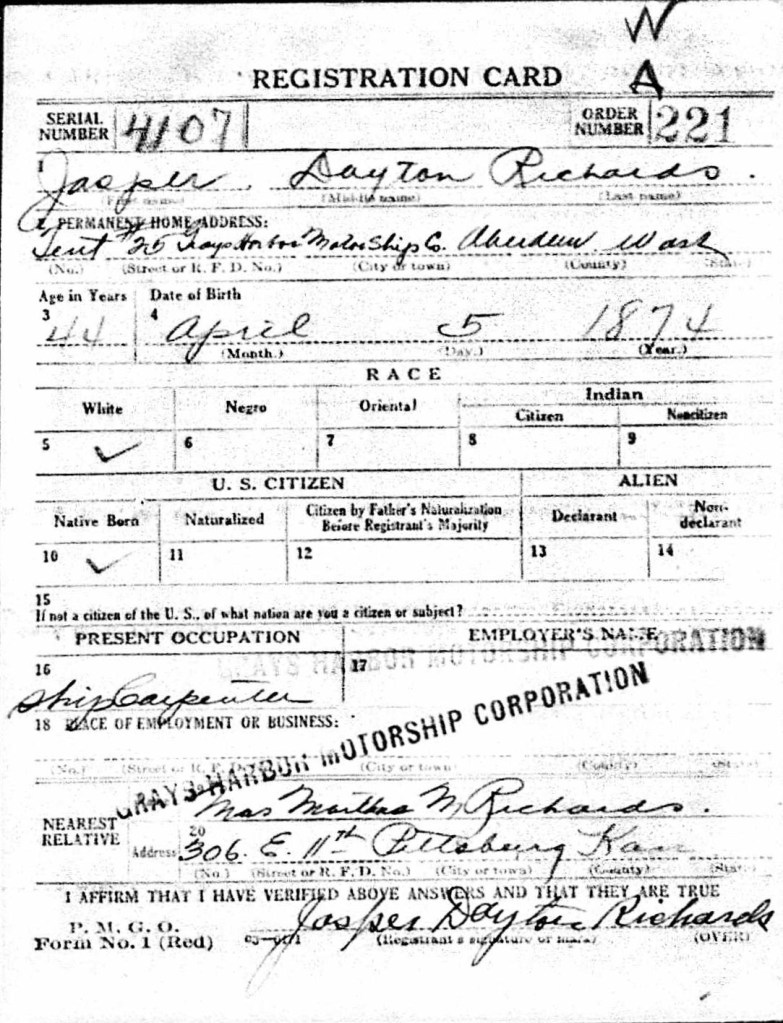
Jasper Dayton Richards’ WWI Draft Registration Card, September 12, 1918
The 1920 U.S. federal census shows us that the Richards household is still living in Pittsburg. By this time, it’s just Martha, Sherman and Jasper. Jasper is 45 years old and works as a carpenter. Oddly, Jasper is listed as “single.” This will come into play in just a moment.

The Richards Family on the 1920 U.S. Federal Census
Martha died in 1929 and is buried in Kansas. The next time we see Jasper is on the 1930 U.S. Federal census. At that time, he was living in the city of Signal Hill, Los Angeles County, California. His address was 1990 Junipero Avenue. He was working as a laborer. Curiously, on this census Jasper’s marital status is listed as “widowed.” Interesting.

Jasper D. Richards on the 1930 U.S. Federal Census
Also, whatever happened to $5.00 rent. Really…Ha!
After this, we don’t see anything from Jasper until that fateful April night in 1934.
The man in the other cottage on Molino Avenue was William Michael Esmay. William was born June 7, 1867, in Sabula, Jackson County, Iowa to Francis Thomas (1829-1899) and Nancy (Seeber) (1829-1904) Esmay. Francis was a carpenter by trade and the proprietor of a planing wood mill. The 1870 U.S. federal census places the Esmay family in Sabula, Jackson County, Iowa, where Francis worked as a carpenter. In 1880, the Esmay family is still living in Sabula, Iowa and Francis opened a planing wood mill. The 1885 Iowa state census tells us that the Esmay family is now located in Union, Jackson County, Iowa and 17-year-old Willie (what William Esmay was referred to as in his younger years) is listed as working as a musician, as is his brother Frank. Apparently, their father was a pretty good cornet player and served as a musical inspiration to at least 2 of his children.

1885 Iowa State Census listing for William “Willie” Esmay and family
Once again, we lose track of the Esmay family, due to the loss of the 1890 federal census. On February 10, 1894, 25-year-old William married 18-year-old Albertha Clynick in Missoula, Missoula County, Montana.

Marriage License of William Esmay and Albertha Clynick, Missoula County Marriage Records
Sometime between 1894 and December, 1900, the couple divorced, as Albertha remarried in December, 1900. We don’t see William again until the 1910 U.S. federal census living in Roundup, Fergus County, Montana. He was working as a miner. In fact, he was doing placer mining for gold. If you have a spare minute, Google “placer mining”, it’s a cool process. It should also be noted that during his time in Montana, William was very involved with local recitals and performances, even having his own band at one time. It seems he was proficient in the playing of piano, violin, and trombone. (Just a note: Those are three VERY different instruments. It says a lot about his musical range.) Also during his time in Montana, William served in the military as bugler, pre-WWI. Sometime between 1910 and 1928, William makes his way to Los Angeles/Long Beach, California area. In 1928, William was living at 1365 Temple Avenue and working as a piano tuner (It’s always nice to see a musician find their niche eventually). The 1930 U.S. federal census and 1931 Long Beach city directory have William still living on Temple Avenue and working as a piano tuner. The 1933 Long Beach city directory shows William moved to Molino Avenue, still tuning pianos.
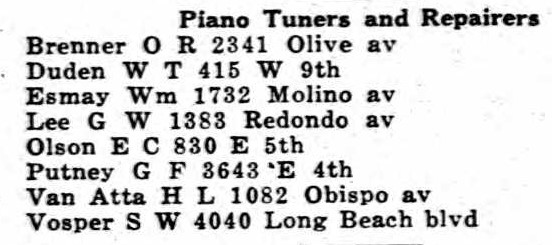
Piano Tuners and Repairers, Long Beach, California City Directory, 1933
We next see William when the newspapers tell of the tragedy on April 28, 1934.
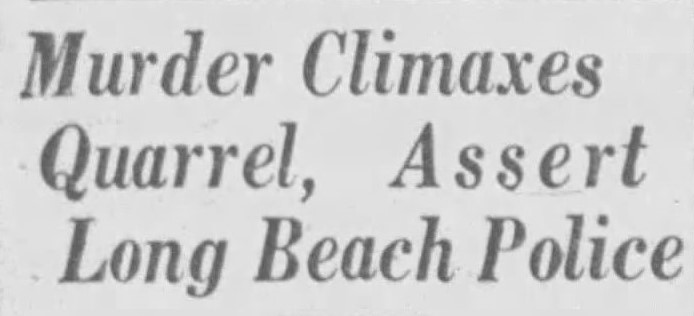
Murder Climaxes Quarrel, Assert Long Beach Police, Illustrated Daily News (Los Angeles, California), April 28, 1934

60-Year Old Man Held in L.B. Ambush Shooting, San Pedro News Pilot (San Pedro, California), April 28, 1934
Apparently, Jasper and William had been in a quarrel and it came to a head with Jasper shooting William once in the chest with a rifle that Jasper had just recently purchased. William had been preparing his dinner in his cottage when a bullet went through his kitchen window and struck him down. Jasper denied shooting William to police but did admit that they had quarreled. Neighbors also said that they had quarreled for several days beforehand. It should be noted that an empty, recently fired rifle shell casing, matching the suspected murder weapon , was found in Jasper’s cottage.
Jasper was arrested and a coroner’s inquest was held on April 30, 1934, at Holton & Son Mortuary. The coroner’s jury concluded that Jasper fired the shot that killed William and Jasper was arraigned for murder and his preliminary hearing set for May 3, 1934.
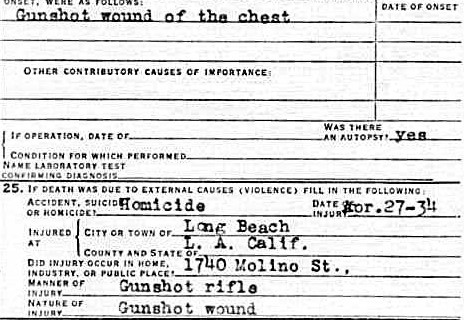
William Esmay’s California death certificate, Local Registered Number 481
After the coroner’s inquest, William’s body was cremated at the Los Angeles County Crematory. The disposition of his remains in unknown.
On May 3, 1934, Jasper attended his preliminary hearing before Judge Charles D. Wallace in the Superior Court. Deputy District Attorney Harry Albert, representing The State, put several witnesses on the stand that said they saw Jasper coming home with a rifle and when they heard the rifle discharge later, they witnessed smoke coming from the screen door of Jasper’s home, with that screen door being in direct line with the kitchen window at William’s house. The screen door to window was measured at 25 feet apart. Police testified that Jasper had told them that he had quarreled with William over a garden hose (It isn’t clear about the whole hose situation and what exactly the issue was). Attorney Jarrett Beckett, representing Jasper Richards, offered no testimony or witnesses for the defense. Beckett did state that a plea of not guilty by reason of insanity might be entered later. Jasper was also ordered to be held with no bail.
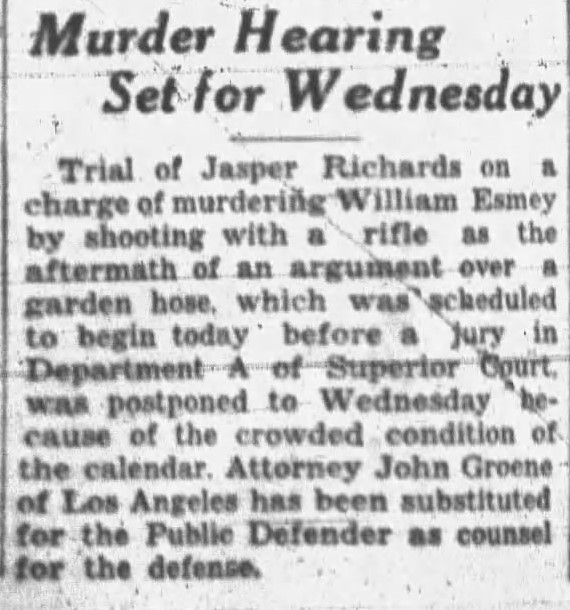
Murder Hearing Set for Wednesday, Long Beach Press Telegram (Long Beach, California), July 3, 1934
It is almost time for Jasper to get his day in court. Apparently, there was a scheduling snafu, as seen in the newspaper clipping above. Also note that Jasper’s lawyer has been substituted.
July 12, 1934- Start of the trial

Trial of Richards Is Begun, The Long Beach Sun (Long Beach, California), July 13, 1934
The Superior Court trial, presided over by Judge Wilbur F. Downs, had a jury of seven men and five women. The State’s first witness called by Deputy District Attorney George E. Glover was Francis Esmay Muse, William’s nephew. Francis testified to identifying his uncle’s body in the morgue. Also of note, Francis is listed as the informant on William’s death certificate as well. The next witness called was police officer L.Q. Martin, who told the jury of the investigation process at the scene of the crime and the conversation with Jasper where he denied firing the deadly shot. The rifle, empty shell casing and live cartridges were entered into evidence.
Day 2 of the trial saw Manuel Weinstein testify for The State that he sold the rifle and cartridges to Jasper. Willard Field and Mrs. Margaret Bowie testified to seeing the smoke from the window. Mrs. Margaret Field, Pike Ellis, Fred Thomsion, and W.F. Rogers testified to hearing the fatal shot. Also testifying for the state on day 2 were: Officer Bud Mhoon (Signal Hill Police Department), Officers L.Q. Martin and Charles Gouthro (Long Beach Police Department). They testified to their investigations of the crime scene and interviews. Also testifying was County Autopsy Surgeon A.F. Wagner. Wagner’s testimony went to the end of the day and court was adjourned for the weekend and would pick back up on Monday, July 16, 1934. It should also be noted, that at this point, the defense has not revealed their defense strategy, however, there were indications in his cross examinations of all the official witnesses called by the state, that the defense would be that the rifle discharged accidently.
Well, I can’t find a newspaper article to explain what happened on Monday. I’m sure that The State presented more testimony that mirrors what has already been said and The State rested its case. That said, on Tuesday July 18, 1934, The defense called several characters witnesses to inform the court that Jasper was an upstanding citizen. After the character witnesses took the stand, the defense called its only other witness: Jasper Dayton Richards. Jasper testified that see bought the rifle and ammunition in question on the day of the shooting but planned to use it for protection while prospecting for gold.
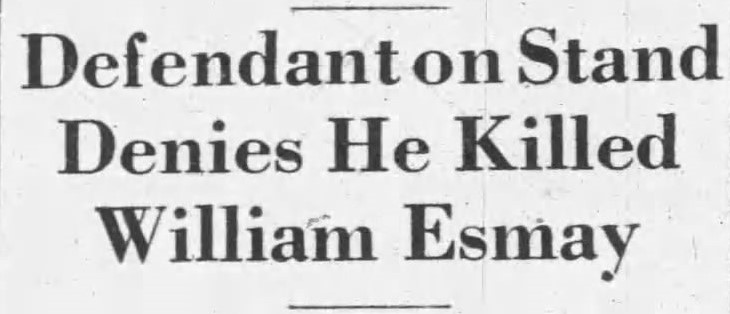
Defendant on Stand Denies He Killed William Esmay, The Long Beach Sun, July 18, 1934
After Jasper was excused from the stand, closing arguments started immediately. District Attorney George E. Glover reiterated that The State would not be asking for the death penalty due to the age of the defendant and his past good character. He contended that Jasper had bought the rifle on the day of the crime, that Jasper had an argument with William Esmay over a garden hose, and that the hole in screen door of Jasper’s front door lined up perfectly to William’s kitchen window and this all proved that the fatal bullet was fired from Jasper’s cottage. The State rested its case.
Jasper’s attorney, John Groene contended in his defense arguments that it would have been impossible for Jasper to have fired the shot, and advanced the theory that William was shot by an unknown enemy who fired a rifle from a nearby street corner. Attorney Groene also pointed out that the hole in the screen door was too high to have been fired by Jasper, unless he stood on a chair or a box. (That is a good point. One wonders how high the hole was. Jasper was about 5’8″, so it would have been towards the top of the door. Right?) He also pointed out that the edge of the hole was covered in rust, indicating that the hole had been made long before the shooting. (Interesting.) In summation, Attorney Groene contended that the prosecution had failed to establish a motive for the crime and that the character witnesses had that Jasper had a “peaceful nature.” The defense rested it’s case and the case was given to the jury for verdict.

Richards Found Guilty in Slaying of Aged Neighbor, The Long Beach Sun, July 19, 1934
The jury deliberated for about 6 1/2 hours. Sentence was set to be passed down on Monday, July 23, 1934, by Judge Wilbur F. Downs.
July 23, 1934
At the beginning of sentencing Jasper’s attorney argued a motion for a new trial. That motion was denied. Attorney Groene then tried to convince the judge that The Court had the power in second degree murder cases to grant the defendant permission to file an application for probation. This too was denied, and Jasper was sentenced. Attorney Groene stated the defense’s intention to appeal this case.
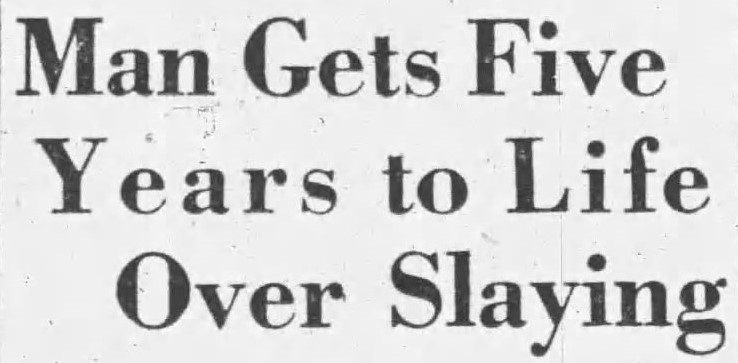
Man Gets Five Years to Life Over Slaying, The Long Beach Sun (Long Beach, California, July 24, 1934)
Nothing is recorded in the newspapers about why it took so long, but Jasper was received at San Quentin State Prison on March 30, 1935, about 9 months after sentencing. Either Jasper went on the lam, held in a smaller jail until he was transferred to prison, or he was free on appeal. Either way, he was finally incarcerated in 1935.

Jasper Dayton Richards Upon Admission to San Quentin State Prison, San Quentin, Marin County, California
This photograph was taken of Jasper Dayton Richards upon his entry into San Quentin. He pops up on the 1940 U.S. federal census as a resident of San Quentin prison. His prison records show no disciplinary actions towards him, and he was paroled on June 30, 1944 after serving 9 years in prison. After this, Jasper disappears from public records. His prison record shows that he was never discharged from parole, so he may have died on parole, probably before 1950. He was about 70 years old when he was paroled.
If you are enjoying our blog, please subscribe and/or comment below! Thank you visiting us! We are so grateful for your interest!
During our genealogical research, CMS Research & Genealogy comes across many stories that have nothing to do with our current project. We have tons of them and will be sharing them all with you on this blog. All the more reason to come back and visit us again!


Check out our archives to read all our posts!
- October 2025
- July 2024
- June 2024
- February 2024
- January 2024
- December 2023
- November 2023
- June 2023
- May 2023
- April 2023
- March 2023
- February 2023

 CMS Research & Genealogy