

Newspapers were and still are (although that is slowly fading away) used as a primary source of reading the news. People used to depend wholly on what was written in the newspaper and sometimes what was written and not written was due to the politics of that newspaper.
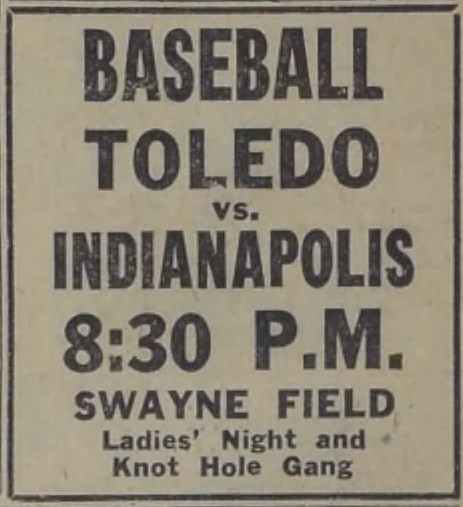
Baseball Toledo, Toledo Blade (Toledo, Ohio), August 25, 1951
Baseball has been a major off and on attraction in Toledo, Ohio since about 1883. The Toledo Mud Hens and the Indianapolis Indians were set to battle on the field on August 25, 1951 at 8:30 P.M. in the Noah H. Swayne Field in Toledo. Does Swayne Field still exist? Mostly no, but a little yes. Eventually, Swayne Field was bulldozed and a small strip mall was built in it’s place. The only remaining part of Swayne Field is the original left field wall separates the mall from the UHAUL storage facility next door.

Pelican Theatre Listing, The Klamath News (Klamath Falls, Oregon), August 5, 1938
It’s movie time! Originally opened as The Poole’s Pelican Theatre in 1929 (owned by Harry W. Poole), the theatre featured some silent films (complete with a huge Wurlitzer organ and a full orchestra), “talkies”, and hosted vaudeville acts from all over the world. It closed in 1960 and the building was razed in 1961 to make room for a bank and parking lot.
Let’s look at what the featured film is. Under Western Stars tells the story of a singing cowboy who decides to run for Congress in order to seek federal assistance to help small ranchers regain their water rights. Starring Roy Rogers (1911-1998), Smiley Burnette (1911-1967), and Carol Hughes (1910-1995), this film was selected to be included in the National Film Registry (2009). Has anyone out there seen this film? Tell us what you think in the comments below.
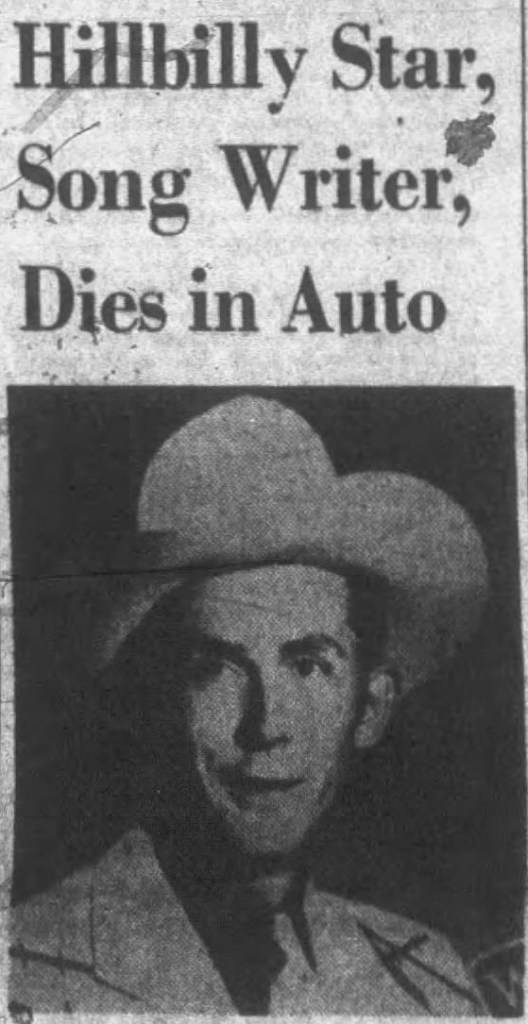
Hillbilly Star…, Nashville Banner (Nashville, Tennessee), January 1, 1953
Hank Williams (1923-1953) had many life problems. Hell, we all do. But do you know what? That dude could write a song with so much raw emotion that it brings the listener to their knees. His death at the age of 29 rocked the country music world to it’s core. Many musicians and songwriters across many different genres have listed Hank as an inspiration and it’s very possible that many more will in the future. He may have died 70 years ago, but his music lives on in so many forms that I wonder if he ever imagined how influential he was.
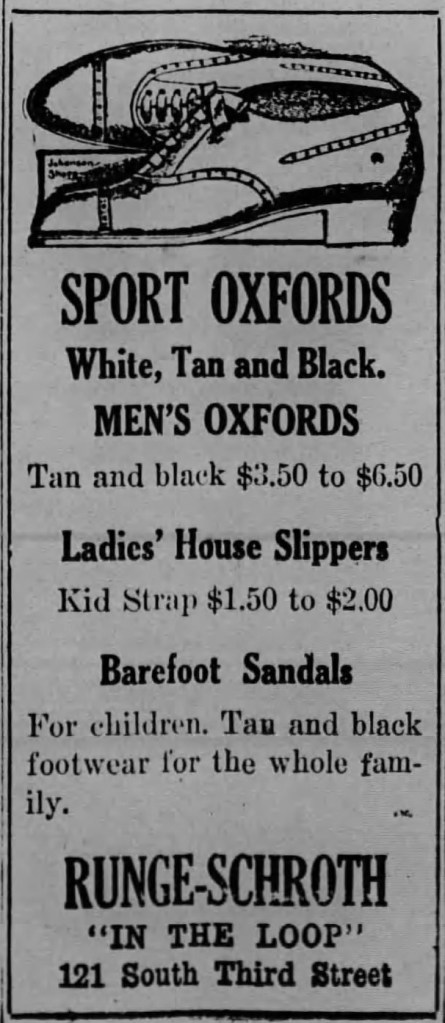
Runge-Schroth Advertisement, The Paducah Sun Democrat (Paducah, Kentucky), June 7, 1917
Did you know that the Oxford style shoe is distinguished by a closed-lacing system, basically meaning that the lace eyelets are placed underneath the facing of the shoe? That said, I’d love to pay those prices for shoes now. Although, that was a lot of money for the time. A pair of those Oxfords with all the bells and whistles, the $6.50 pair, would be the equivalent of paying about $166 today. The dream of paying $6.50 for a roughly $160 pair of shoes doesn’t change. If you’re ever in Paducah, Kentucky, stop by 121 South Third Ave. and remember that in 1917 there was a shoe store there. The same building still stands there, however, it is a clothing store now.
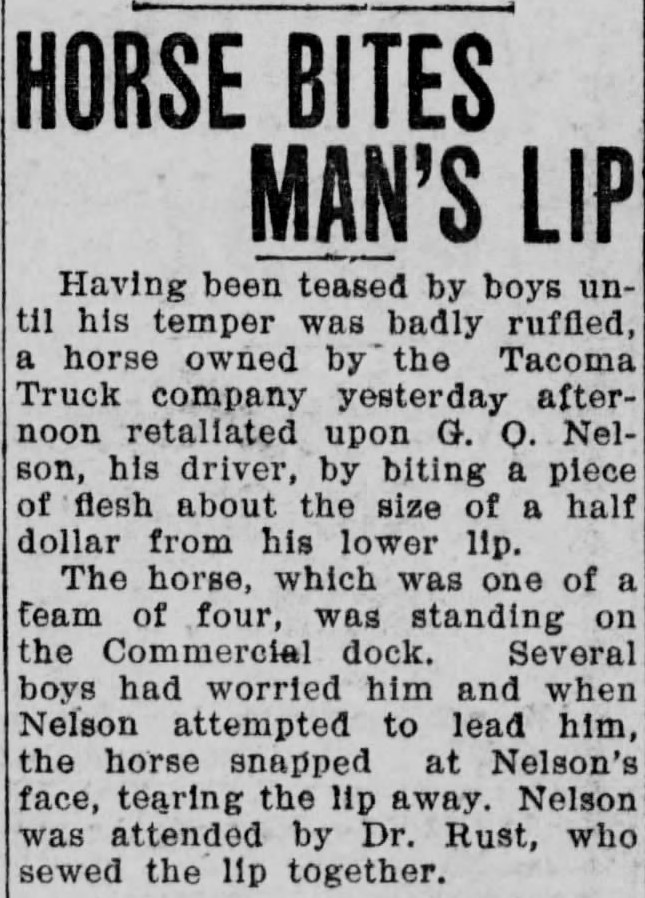
Horse Bites Man’s Lip, The Tacoma Times (Tacoma, Washington), May 18, 1907
Ouch. Horses don’t have sharp teeth either. That has to really hurt. Our preliminary search didn’t yield any information on G.O. Nelson, but we did find Dr. Rust. Chancy G. Rust was born 1873 to Samuel and Isabell (Martin) Rust in Missouri and was a physician and surgeon in Tacoma, Pierce County, Washington by 1900. He never married. He died of cancer of the left arm and axilla (the armpit) on August 2, 1931 in Tacoma. He was 58 years old. He is entombed at Tacoma Mausoleum, which is about 10 minutes from his home and place of death.

John Zurfluh Advertisement, The Perrysburg Journal (Perrysburg, Ohio), April 10, 1914
Johann “John” Zurfluh was born to Johann and Elizabeth (Stauffer) Zurfluh on August 13, 1833 in Switzerland. It’s not really documented or implied how John got started in the timepiece and jewelry business. He was married to Rosina Afflater (1833-1915) in 1853 in Switzerland. They had 11 children. The family immigrated to America circa 1870. It’s unknown if John’s shop at 906 Monroe Street, Toledo, Lucas County, Ohio was his only shop, but sadly, the building has been demolished and there is a parking lot there now in 2023. John died at his home in Toledo on January 28, 1922 at the age of 88. The cause of death was valvular heart trouble and bronchial pneumonia. He was buried next to his wife at Fort Meigs Cemetery in Perrysburg, Wood County, Ohio.
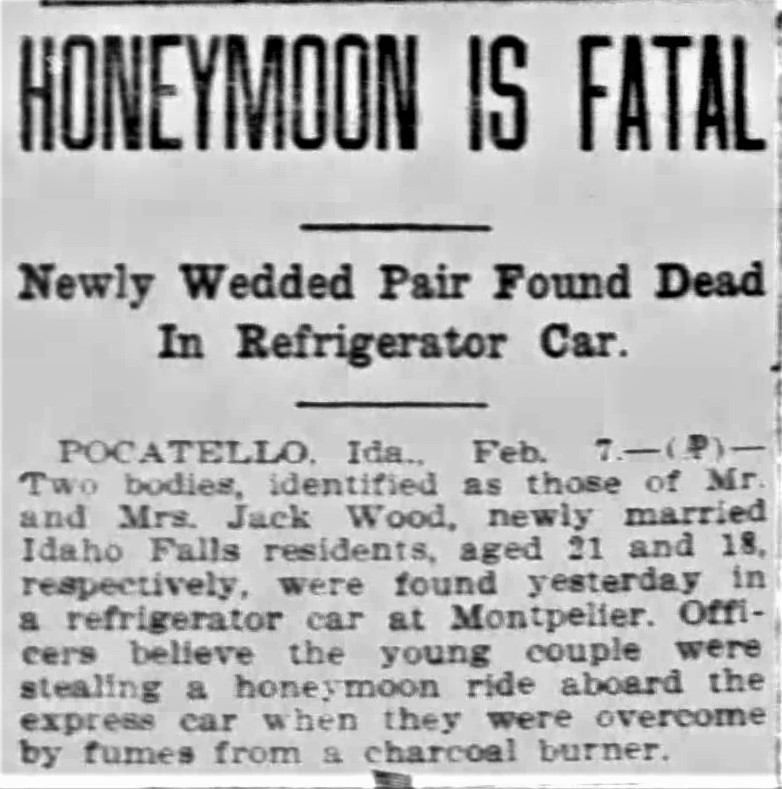
Honeymoon Is Fatal, The Bellingham Herald (Bellingham, Washington), February 7, 1923
Warning: this is a tragic story. Early on the morning of February 5, 1923, the lifeless bodies of 2 people were found in a potato train car, #16841, owned by the Pacific Fruit Express at the in Montpelier, Bear Lake County, Idaho. At first the bodies were not identified, by police investigators soon identified them as Jack Wood, age 26 and his wife Callie L. (Colson) Wood, age 18, living in Pocatello, Bannock County, Idaho at the time of this incident. The coroner of Bear Lake County at the time, F.M. Williams, soon returned a cause of death for both of the deceased as “Asphyxiation from charcoal gas fumes.” They had been using a charcoal burning heater in the train car. The train car was fitted with this heater to keep the potatoes it was hauling from freezing in the winter cold. Sad and accidental.
Callie had just graduated from high school at Idaho Falls High School, class of 1922, probably in May or June of that year. She was known to have performed several short jobs as a stenographer in the Idaho Falls, Bonneville County, Idaho area. It’s unknown, to us anyway, how Jack and Callie came to meet, but we do know that they were married on December 14, 1923 in Rigby, Jefferson County, Idaho. The wedding was officiated by the mayor of Rigby, Bash L. Bennett (1874-1945), in the presence of witnesses, Axel John Staley (1899-1977) and Ellen A. Staley (1899-1999). It’s unclear if the mayor or the witnesses even knew the bride and groom. After the marriage, Jack and Callie were living in Pocatello and Jack was working in a cigar shop. It is unclear if Callie was working at this time. They had moved into the rented home that Jack had secured several months earlier, when he arrived in town.
Let’s get into more some information about Callie and Jack. She was born to Samuel Glover (1875-1925) and Nancy Jane (Ross) (1878-1964) Colson on November 26, 1904 in Grundy County, Tennessee. Samuel had worked as a coal miner in Tennessee until the family moved to Idaho in 1907. He was briefly a farmer and then worked as a mechanic after moving to the Idaho Falls area. She had several siblings. It appears they all outlived Callie.
It appears that the investigators identified the bodies of the deceased by the marriage license that was in their possession on that fateful morning. The coroner was in contact with Callie’s parents who traveled to Montpelier to identify and claim the body of Callie.
Unfortunately, Jack’s family could not be easily found. In the meantime, Callie’s parents claimed his body as well and had him buried by his wife. The coroner and sheriff’s department worked to find the identity of Jack’s parents and fielded several missing persons inquiries and Jack was exhumed at least once for identification. It is unclear how the coroner and other investigators found the linking clue, but they learned that Jack Wood was an alias used by James Riddle.
Going over the scant information related to him, it’s possible that James’ short life was less than pleasant. James Riddle was born to Sampson Aquilla “Quiller” (1874-1928) and Martha (Siler) (1874-1960) Riddle on April 26, 1896 in Wildie, Rockcastle County, Kentucky. Sampson was a farmer who got into a little trouble later in life for “gaming” crimes. In 1900, the U.S. federal census records the Riddle family (Sampson, Martha, James and 2 of James’ sisters) as living in Rockcastle County, Kentucky. Sampson was working as a farmer. Sometime before 1904, Sampson and Martha divorced. and Sampson remarried. Sampson lived most of the rest of his life in Kentucky ad the last years of his life in Ohio.
In the 1910 U.S. federal census, James, age 14 (the census was enumerated on his birthday), lived with his paternal grandmother, Mary Jane (Grady) (1841-1916) Riddle and one of his sister in Roundstone, Rockcastle County, Kentucky. James’ mother, Martha, lived in the Bell County, Kentucky in the home of James and Roxie Woods with 3 of her children. Martha was working as a servant. Divorce caused a horribly broken home.
But what happened to James between 1910 and 1923? That information is quite spotty, but the next time he pops up is on June 5, 1917 in Kenosha County, Wisconsin. On this date, James filed out his World War I draft registration card. He was working as a laborer at the Pennoyer Sanitarium in Somers, Kenosha County, Wisconsin. At his time, he was described as tall, slender and had blue eyes and light hair. Curiously, James wrote that he was currently a private in the Iowa National Guard. What brought him to Wisconsin? How did Iowa fall into all this? Good question and one that will remain vague for the rest of this story. On August 15, 1917, James is included in a list posted in the Kenosha Times as one of 108 men from Kenosha County who were called into active military service. On September 6, 1917, James is again listed in the Kenosha Times, this time as one of 23 men in Kenosha County called “shirkers” because he didn’t report for military duty as instructed. The Kenosha County sheriff was sent to retrieve them. It is presumed that James was located as he was listed in the 1920 U.S. federal census as a U.S. Army soldier living in Camp Eagle Pass, Maverick County, Texas.
Unfortunately, nothing else is known about James until he was identified as “Jack Wood” in February of 1923. How he ended up in Idaho and took an alias is lost in history or so it appears. This story left us with more questions, but there were a lot of answers to who Jack Wood really was.
Also, it appears that Jack and Callie were headed back East for a honeymoon as stowaways in the train car. That is a huge tragedy.
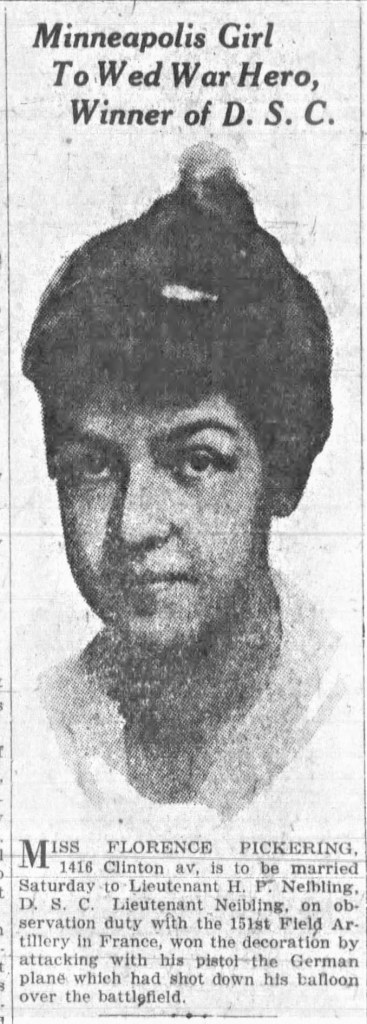
Minneapolis Girl To Wed War Hero, The Minneapolis Journal (Minneapolis, Minnesota), November 20, 1919
Florence Lois Pickering was born to Edgar Job (1854-1936) and Carrie Amelia (Garvey) (1861-1932) Pickering on August 24, 1894 in Minneapolis, Hennepin County, Minnesota. She was the sister to 3 siblings (2 brothers and 1 sister). Edgar worked as a superintendent of a flour mill. They seemed to be a very well-off family.
Then a war hero won her heart. It’s uncertain if Florence knew H.P. Neibling before he served in WWI, but it is known that during his service he earned the Distinguished Service Cross, the story of how he earned it it it briefly noted in the above article.
Harlon (or Harlou) Paul Neibling was born to Lawrence Larone (1857-1905) and Elizabeth A. (Grenard) (1864-1943) Neibling on March 12, 1894 in Huron, Beadle County, South Dakota. Harlon generally used his middle name as his first, so we will refer to him as “Paul” here. Lawrence worked as a railroad engineer. After he died in 1905, Elizabeth and Paul can be found in Minneapolis city directories after 1909. Paul served honorably in WWI in France.
So, they got married right? Yup, Paul and Florence were married on November 22, 1919 in Minneapolis. Afterwards, They lived primarily in the St. Paul- Minneapolis area for most of their working lives. Paul worked in various positions for several manufacturing businesses and Florence was a homemaker, raising at least 2 children.
They were married for 57 years when Paul passed away in Todd County, Minnesota at the age of 82. Florence passed away on September 20, 1985 in Stearns County, Minnesota at the age of 91. The sweethearts are buried at Lakeview Cemetery in Grey Eagle, Todd County, Minnesota.

Duffy’s Malt Whisky Co. Advertisement, The Philadelphia Inquirer (Philadelphia, Pennsylvania), March 23, 1900
Malt whiskey may cure many things, but do you think it would cure the flu and TB? Just a quick note that Duffy’s was the only patent medicine of it’s time to actually contain real whiskey. Would you give it a try if you were ill?

Belcourt Playhouse Listing, Nashville Banner (Nashville, Tennessee), March 5, 1963
Probably the best news is that the Belcourt Theatre is still standing and active, just south of Vanderbilt University in Nashville, Tennessee! Rita Tushingham ‘s (1942-) first movie was A Taste of Honey (Released in 1961), a British drama film directed by Tony Richardson (1928-1991).
Here we are at the conclusion, my friends. Thank you for joining us on our brief trip back in history. Be safe and remember to love one another.
During our genealogical research, CMS Research & Genealogy comes across many stories that have nothing to do with our current project. We have tons of them and will be sharing them all with you on this blog. All the more reason to come back and visit us again!
December 6, 2023

We would love to hear from you!
Don’t Forget To Subscribe!

Check out our archives for more reading material!
- October 2025
- July 2024
- June 2024
- February 2024
- January 2024
- December 2023
- November 2023
- June 2023
- May 2023
- April 2023
- March 2023
- February 2023

 CMS Research & Genealogy
Leave a comment