
“I shot Andrew Reilly because he insulted my wife” is what Harry Radcliffe told a San Francisco Call newspaper reporter. Harry continued, “My wife was waiting for me at the corner of Ninth and Folsom at 1 o’clock this morning. Reilly approached and insulted her grossly. I followed him and killed him.”
Well, that doesn’t sound good for Harry. Truth is, things were about to get a bit worse.
Captain Martin brought in Harry’s wife, Marion. Her statement to police was short and to the point. “I was not with my husband at 1 o’clock. I have never seen Reilly at any time and he has never spoken to me.” After her statement was entered into the record, Dr. John J. Keefe, Harry’s half brother, advised that Marion go into hiding until Harry could secure a lawyer.
Uh oh.
Let’s rewind a little bit and get some background information out of the way.
Andrew Riley (sometimes Reilly; contemporary documents and newspapers use both spellings) was born circa 1876 in Ireland. He was employed as a laborer and was working as a hod carrier in the time right before his death. We also know that he was a Catholic. Sadly, more is known about his death than his life, but we will get into that in a bit. As of 1904, he had lived at 25 Sheridan Street in San Francisco for about 4 years. This was the home of Mr. and Mrs. James Cox and their family. Also, Andrew was set to be married soon to Ellen Riley (Same last name, probably not related already). Andrew had also made several trips to Alaska to mine for gold and had been quite successful in these endeavors.
Harry Richard Radcliffe was born April 14, 1883 in Ruby Hill, Eureka County, Nevada to Irish immigrants Henry Radcliffe (Sometimes Ratcliffe) (circa 1840- ), a miner, and Bridget M. (Callahan) (circa 1849-1928). Just a quick note that Ruby Hill is now a ghost town, which has an interesting history. Check it out here. Sometime between 1883 and 1890, the family moved to San Francisco, San Francisco County, California, where Henry is documented as applying for naturalization. After that, Henry drops from public record. We don’t hear about Harry Richard again until he married Marion June Badger (1884-1973) on June 12, 1904 in Alameda County, California.
So, fast forward to 1904. Andrew Riley, a good natured, hard working man, is walking down Ninth Street in San Francisco at about 1 o’clock AM on June 26, 1904 in San Francisco. A scuffle occurs with Harry Richard Radcliffe and Andrew Riley is shot once in the head. According to the coroner’s report, it was a single shot from a small caliber revolver that entered the temporal region of Andrew’s brain. Fighting for his life, Andrew was rushed to nearby Central Emergency Hospital in the basement of the City Hall, where he died shortly thereafter. (An interesting note: that particular City Hall no longer exists, as it was destroyed in the 1906 San Francisco Earthquake. After said earthquake, a new City Hall was built, just to the West of the old location.) After an autopsy was completed, Andrew was buried two days later on June 28, 1904 in Holy Cross Catholic Cemetery in Colma, San Mateo County, California. His distraught fiancée was said to have mourned the hardest.
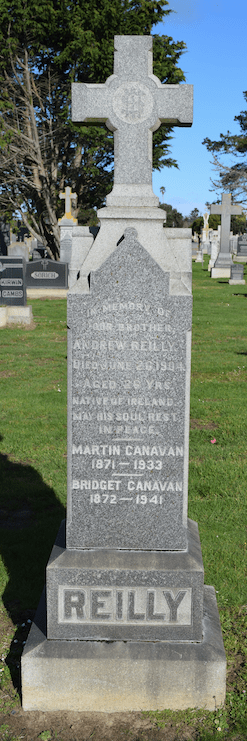
The grave of Andrew Reilly (Riley); Photograph courtesy of Tom Brocher of FindaGrave
At the beginning of this article, we wrote of the conflicting accounts supplied by Harry and Marion Radcliffe. Here are some likenesses of the characters of this story, per a contemporary newspaper:
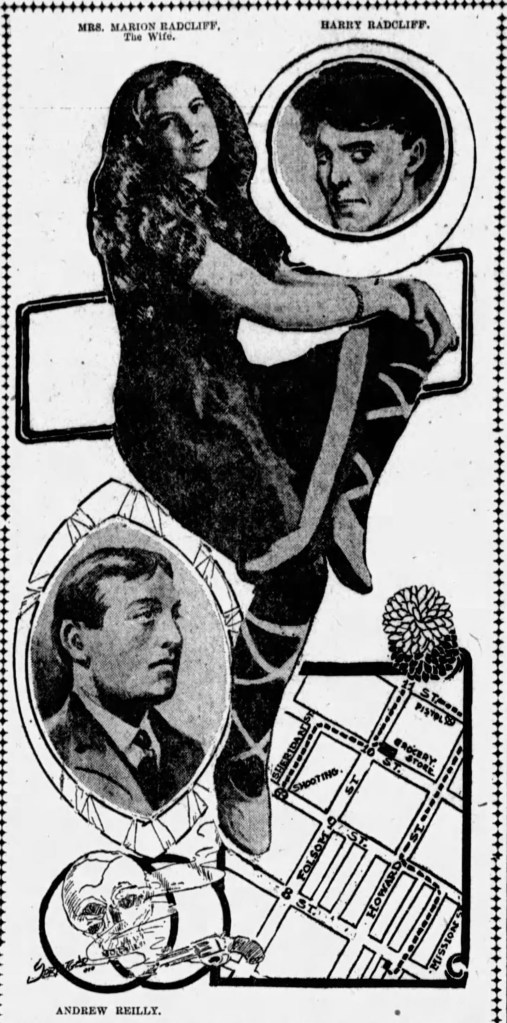
Marion, Harry and Andrew, The San Francisco Examiner (San Francisco, California), June 27, 1904
Here is what they police investigation uncovered. There was nobody who saw the actual shooting. Harry gave his side, but Andrew was unconscious until his death. Shortly after 1 AM, Harry burst into a saloon at Tenth and Folsom streets. Chris Sullivan and G.H. Harris were standing at the bar. At this point, Harry loudly asked Sullivan for his hat, but before Sullivan could respond, Harry snatched the hat and ran out of the saloon. Harry then headed at a run to his home at Eighth and Minna streets. Meanwhile, San Francisco policemen N.F. Dunne and Annear, who had heard the gunshot, arrived at the scene of the shooting, where Andrew lay in a pool of blood. Several people had converged on the scene by that time. Two hats were on the sidewalk. One was Andrew’s and one was Harry’s. Andrew was rushed to the hospital.
San Francisco Police Sergeant Bush arrived at the scene with a posse shortly after Andrew was taken away. The policemen began to blanket the area in search of clues to this seemingly senseless murder. They came upon Timothy J. Maloney, a street sweeper, who had seen a bareheaded man running down Tenth Street. They followed this clue to Sullivan and Harris, who were now standing outside the saloon waiting for Harry to return, thinking that they were just part of a hat stealing prank. Sullivan was, apparently, familiar with Harry and directed the policemen to the home of Harry’s mother at 1110 Folsom Street. She, in turn, directed them to Harry’s home.
When Sergeant Bush and Policeman Robert A. Curtin confronted Harry at the entrance of his room, he gave up and was handcuffed without incident.

I Give Up, The San Francisco Call (San Francisco, California), June 27, 1904
While doing a search of the room, police found bloody clothing on the floor and there was evidence that the clothing had undergone quick efforts to cleanse them of blood. A bloody towel was also found.

When Questioned…, The San Francisco Call (San Francisco, California), June 27, 1904
The revolver was found at 5 AM that same morning by police at 225 Eleventh Street. Two of the chambers were empty.
Harry, now under arrest, complained of suffering injuries from a blow to the head that he received during a scuffle with Andrew. He was taken to Central Emergency Hospital at City Hall to receive treatment. At this time, Harry was not cooperative and refused to speak to the police officers. He did speak to a reporter from The San Francisco Call newspaper though and here is his statement:
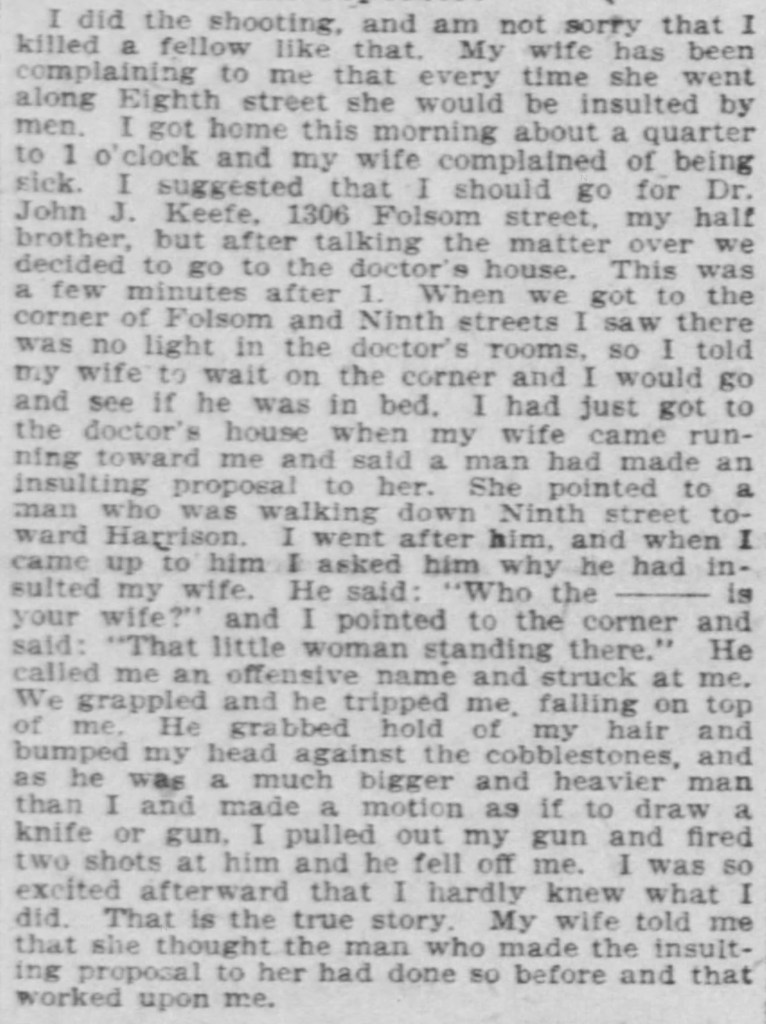
I Did The Shooting…, The San Francisco Call (San Francisco, California), June 27, 1904
The claims in the statement stating that Andrew fought for his life seem to be correct, given the injuries that Harry received. Harry suffered from a lacerated scalp on the back of his head and a pretty bad hematoma on his chest. There were also scratches on his face.
Harry also said that he was born in Nevada, but had lived in San Francisco for most of his life. He also says that he has not been employed since June 10th, 1904. Prior to that, he had worked as a porter at St. Francis Hotel and before that, he had worked as a janitor at the Central Theatre. Previous to that, he had worked in an unknown capacity for his half brother, Dr. John J. Keefe.
Marion was rushed to Dr. John J. Keefe’s office shortly after Harry was arrested. She talked to Captain Martin right before her husband gave the above statement. That is when she denied knowing anything about the incident. She was then taken away to Dr. Keefe’s by her landlord, William Quayle. The police at this point are thinking that the killing was an attempt at robbery. The evidence of this was strongly circumstantial, however it fit the mold.
After his wounds were treated, Harry was booked in the city jail where, on jail documents, he gave his age as 21 and was a native of Virginia City, Nevada. He also stated that he was a porter and had been out of work for some time. He also said that he had only been married to Marion for two weeks.
Andrew Reilly (Riley) was described by both police and newspapers as:

Riley was…, The San Francisco Call (San Francisco, California), June 27, 1904
William Quayle, the Radcliffe’s landlord, was the proprietor of the Cape Breton lodging house. He gave this statement to police:
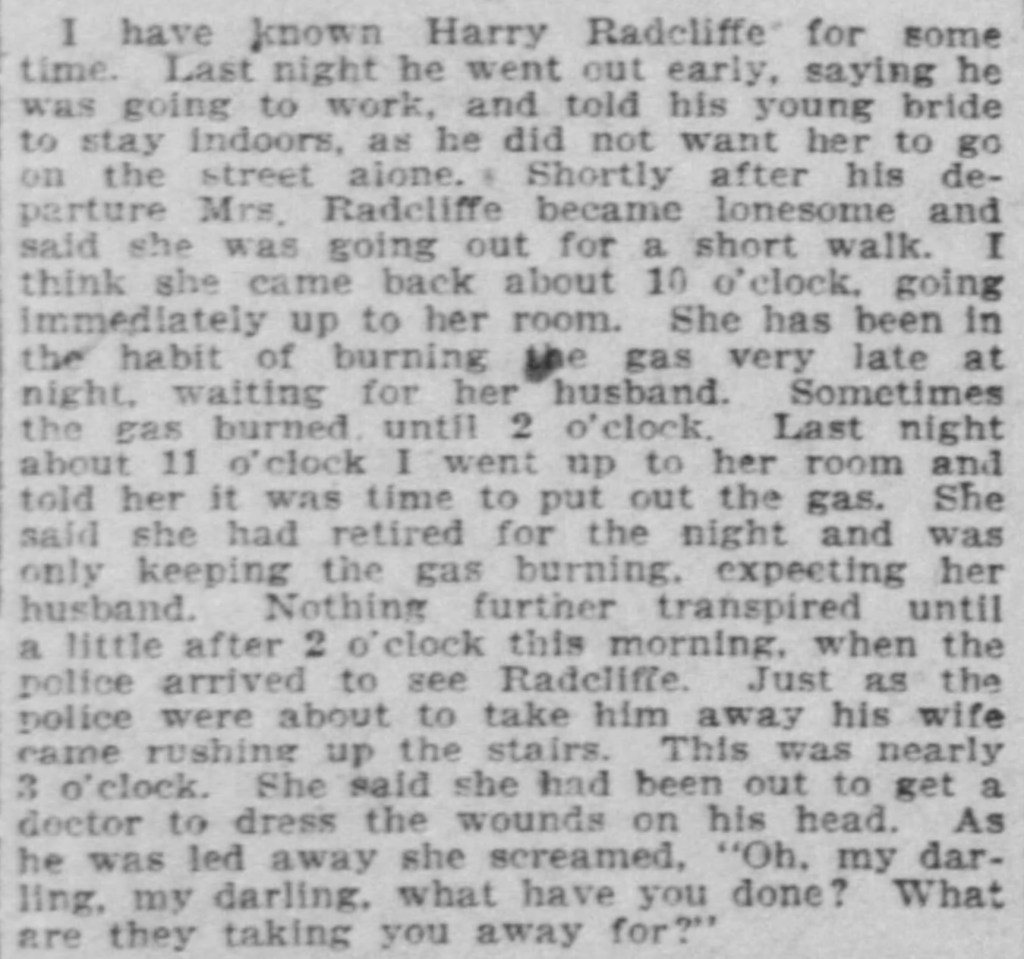
I have known Harry Radcliffe…, The San Francisco Call (San Francisco, California), June 27, 1904
The police were satisfied that Quayle’s statement corroborated Marion’s version of events.
Anna Bidwell gave a statement to police that morning. Bidwell lived at 321 Ninth Street, across the street and a quarter block from the crime scene. She said she was awakened by two men scuffling and arguing on the street near her window. then she heard a gunshot, followed by another gunshot a few seconds later. By the time she had walked to the window, she saw Andrew laying on the sidewalk. When asked if she had seen Radcliffe at the scene, she said she had not.
On Friday, July 1, 1904, a coroner’s inquest was convened with the purpose to find the cause of Andrew Riley’s death and to recommend an indictment, if necessary. John Besser was the first witness called. Besser stated that he was walking about half a block from the scene. He ran over to where Andrew lay and picked up two hats. One was identified as Andrew’s and the other one identified as Harry’s. Besser identified the hats presented as evidence at the coroner’s inquest, as the two he saw at the scene of the crime. At this time, Coroner Leland told the jury that the hat which was identified as belonging to Harry, had the name of the maker and all other marks of identification removed.

John Besser…, The San Francisco Examiner (San Francisco, California), July 2, 1904
Testifying to hearing the gunshots and responding to the scene were: George Claytor, a milk wagon driver; Margaret Noonan, who lived close to the scene; Special Policeman Dunn; Policemen N.F. Dunne, Annear, Kennedy, and R.E. Summers, a night watchman in a nearby building.
Chris Sullivan also testified that a bloody, bareheaded, and breathless Harry Radcliffe entered the saloon (Although the article states that this scene of this encounter was a store. There actually was a saloon and a store next to each at this site during this time.) and snatched his hat saying:

Mum’s The Word, The San Francisco Examiner (San Francisco, California), July 2, 1904
Policeman Robert A. Curtin and Sergeant Bush also testified to the coroner’s jury how they traced Harry’s movements from the crime scene to Harry’s home and told of his arrest.
The jury was out for only a short time and delivered a verdict to indict Harry Richard Radcliffe for the crime of murder. When the verdict was delivered, Harry displayed an indifferent smile and walked jauntily from the courtroom surrounded by jail guards. He would remain in city jail until his trial.
Harry appeared before Police Judge Fritz on Wednesday, July 6, 1904 for his preliminary hearing. The prosecution went on record to say that they were not ready to proceed and Judge Fritz postponed the hearing until July 7, 1904 to allow the prosecution time to prepare. Harry appeared again on July 7th and no new important facts (Other than the findings of the coroner’s inquest) were entered to the record and Judge Fritz ordered Harry held to answer for the death of Andrew Riley. We can’t find anything stating that Harry plead “not guilty”, however we assume that he did so.
Harry’s trial was set to begin on November 2, 1904 in the Superior Court, with Judge Carroll Cook presiding.
November 2nd rolled around and the jury had just been empaneled when Assistant District Attorney R.P. Ashe received a telegram from George L. Claytor, of Soulsbyville, Tuolumne County, stating that he could not attend the trial. ADA Ashe read the telegram to the Judge and stated that Claytor was the principal witness for the state and the case could not proceed without him. The Judge ordered an arrest warrant be issued and a deputy sheriff leave on the next train to Soulsbyville and bring Claytor back with him. The case was then continued until November 3rd, pending the locating and transport of Mr. Claytor to San Francisco.
When court was convened on November 3rd, Claytor gave his testimony that he witnessed Harry Radcliffe running away from the direction of the crime scene. He also that Harry was hatless and covered in blood. The defense had no cross examination for this witness. The prosecution rested.
First on the stand for the defense was Marion Radcliffe, Harry’s young bride. She had changed her story to almost match that of her husband. She told it in a very straightforward and convincing way that if the prosecution hadn’t been ready for this, the defendant would have probably been acquitted. At least, that is how the newspapers had put it. According to Harry’s statement, he left his wife at the corner of Ninth and Sheridan streets while he went to the home of Dr. Keefe for the purpose of getting some medicine for Marion. Dr. Keefe’s home/office was half a block away. While he was retrieving the medicine was when Andrew Riley accosted Marion with his insulting proposal.

Youthful Wife…, The San Francisco Examiner (San Francisco, California), November 10, 1904
Marion’s testimony corroborated Harry’s statement. She testified that on the night of the murder, Harry had come home after midnight. Marion was feeling ill and begged Harry to go to Dr. Keefe for medicine. While on the way, they passed a few people, including two policemen who were standing on the corner of Eighth and Folsom streets. Marion described the shooting as follows:
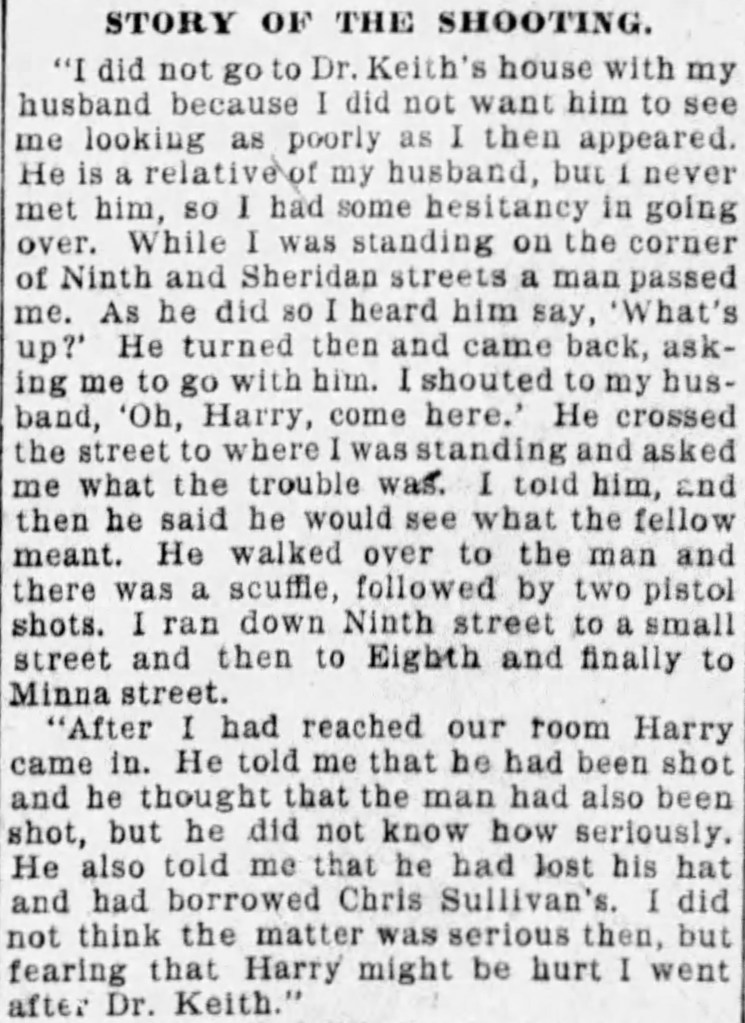
Story of the Shooting, The San Francisco Examiner (San Francisco, California), November 10, 1904
DA Lewis F. Byington then asked Marion why she had lied when first interviewed by police on the morning of the murder. Marion stated that she didn’t want them (the police) to know what had happened, but decided to tell the truth when she realized how serious the situation was for her husband. The DA then asked Marion why she had also lied to Detectives Braig and Bailey by telling the same false story. She admitted that she had made a false statement, but justified it by saying that she wanted to hide her part in the whole incident. She also told the DA that she was unaware of her husband carrying a pistol on that night. The pistol was said to be stolen from an adjoining room to the Radcliffe’s room several days before the shooting. Judge Cook made a ruling that barred evidence which would prove that the pistol was, in fact, stolen.
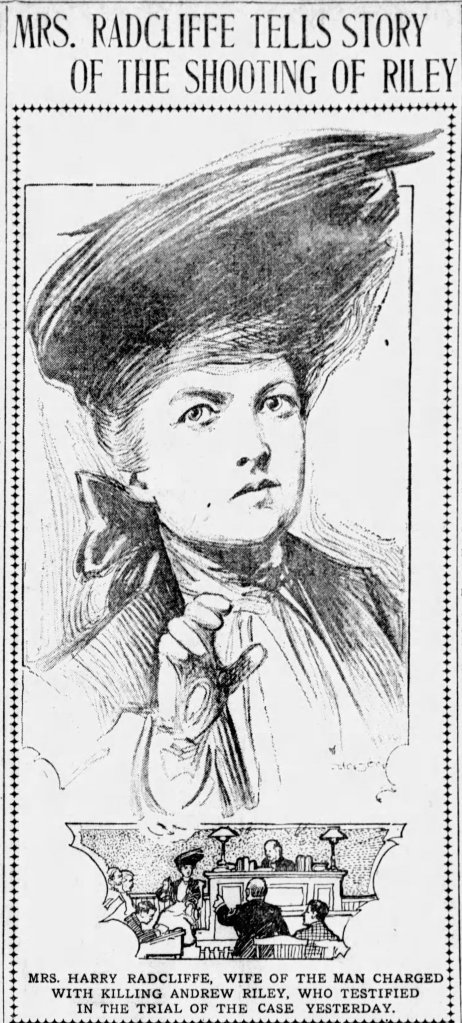
Mrs. Radcliffe Tells Story…, The San Francisco Examiner (San Francisco, California), November 10, 1904
Next on the stand for the defense was Adele McGuire of 2221 Jackson Street and Marion’s sister. At the time of Harry’s arrest, police found a piece of cloth in his pocket that they believe he intended to use as a mask. Adele testified that a few nights before the shooting, Harry and Marion had visited her home. During the evening, the cloth had been used as a skirt for her dog. Harry had taken the cloth from Marion and put it in his pocket.
After Adele’s testimony had concluded, the defense rested their case. ADA Ashe began the closing arguments for the prosecution and was followed by Carl H. Lindsay for the defense. DA Byington concluded for the prosecution and the case was handed to the jury on Thursday, November 10, 1904.
After deliberating for fourteen hours, the jury was unable to agree on the verdict. The vote was deadlocked at 9 for acquittal and 3 for finding Harry guilty of murder. Judge Cook declared a mistrial and ordered Harry continue to be held in jail while awaiting a new trial. Harry and Marion were quite relieved when they heard that the jury was deadlocked.

Radcliffe Jury…, The San Francisco Call (San Francisco, California), November 12, 1904
Harry Radcliffe’s new trial was scheduled for Wednesday, December 7, 1904 in the same Superior Court of Judge Carroll Cook.
There is far less information available on the second trial. It’s unclear what the prosecution and defense changed (The defense still put Marion on the stand and she repeated that she had lied in her first statement to police) in their handling of the case, but we do know that the case went to the jury Friday, December 16, 1904.
The jury came back on December 19, 1904 with a verdict of guilty for murder in the second degree.
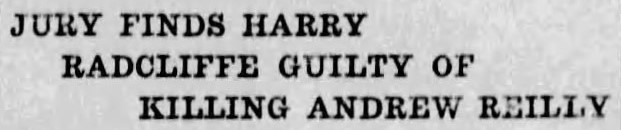
Jury Finds Harry Radcliffe Guilty…, The Recorder (San Francisco, California), December 20, 1904
When the verdict was read, Harry showed no emotion, as did Marion until she broke down in tears after a couple minutes. As it turns out, the jury said that the verdict was a compromise.
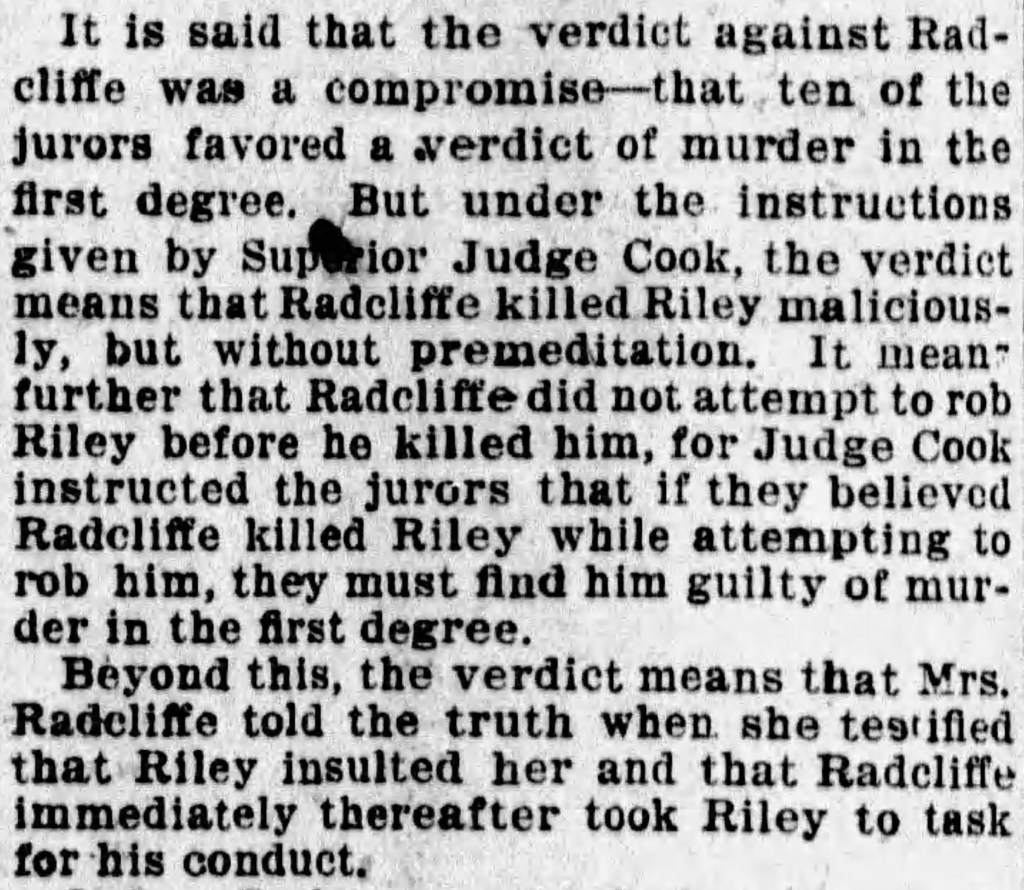
It Is Said That…, The San Francisco Examiner (San Francisco, California), December 20, 1904
Judge Cook then announced that he would sentence Harry Radcliffe on December 31, 1904. The minimum punishment for murder in the second degree (In 1904) is ten years imprisonment and the maximum is life imprisonment. It also said that Harry’s attorney will probably move for a new trial. Ultimately, the attorney for the defense filed accusations of about forty alleged errors by the Judge and the District Attorney. Judge Cook ordered that briefs be submitted by each side on the points raised and postponed sentence until February 17, 1905.
After another postponement, Harry’s sentencing finally began on Friday, March 25, 1905. Apparently, Harry had been defiant, arrogant and insubordinate in jail. Judge Cook, armed with this knowledge, inquired if there was any reason why sentence should not be imposed. Defense Attorney asked for mercy of the court because Harry was still youthful and of former good character. Judge Cook then ordered that the sentencing be postponed until the following Monday, March 27, 1905, so that character witnesses could be sought out by the defense.
On March 27, 1905, Judge Cook heard the testimony of several witnesses who told of Harry’s good character before the crime. They were Thomas F. O’Connor, Dr. H.T. Wilson, G.P. Wilson, and Harry’s half brother Dr. John J. Keefe. Judge Cook held that this testimony was admissible inasmuch as the jury had found Harry guilty of murder in the second degree, which permitted to a wide range of sentencing to be used.
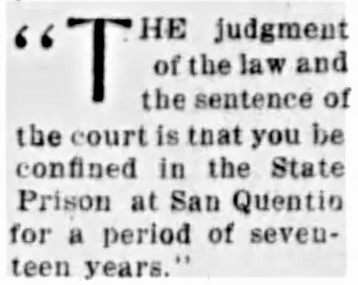
The Judgement of the Law…, The San Francisco Examiner (San Francisco, California), March 28, 1905
After the sentence was pronounced and Harry Radcliffe was given a term of 17 years to be served, Marion burst out into hysterical sobs. She was then removed from the gallery of the courtroom to the hallway where she fainted. In the end, she was medically fine, just overcome by emotion.
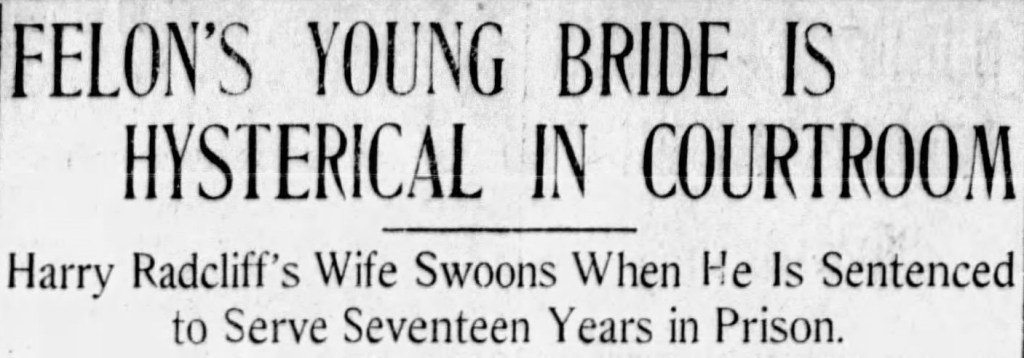
Felon’s Young Bride…, The San Francisco Examiner (San Francisco, California), March 28, 1905
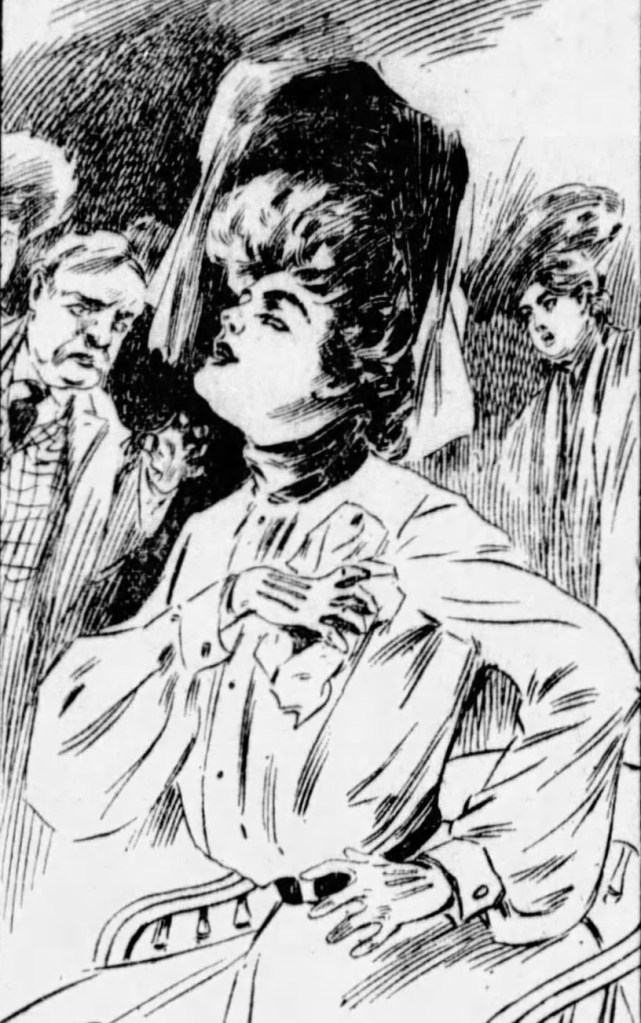
Marion Radcliffe at Harry Radcliffe’s sentencing, The San Francisco Examiner (San Francisco, California), March 28, 1905
Harry was finally received at San Quentin Prison on May 3, 1905. Here is his mugshot.
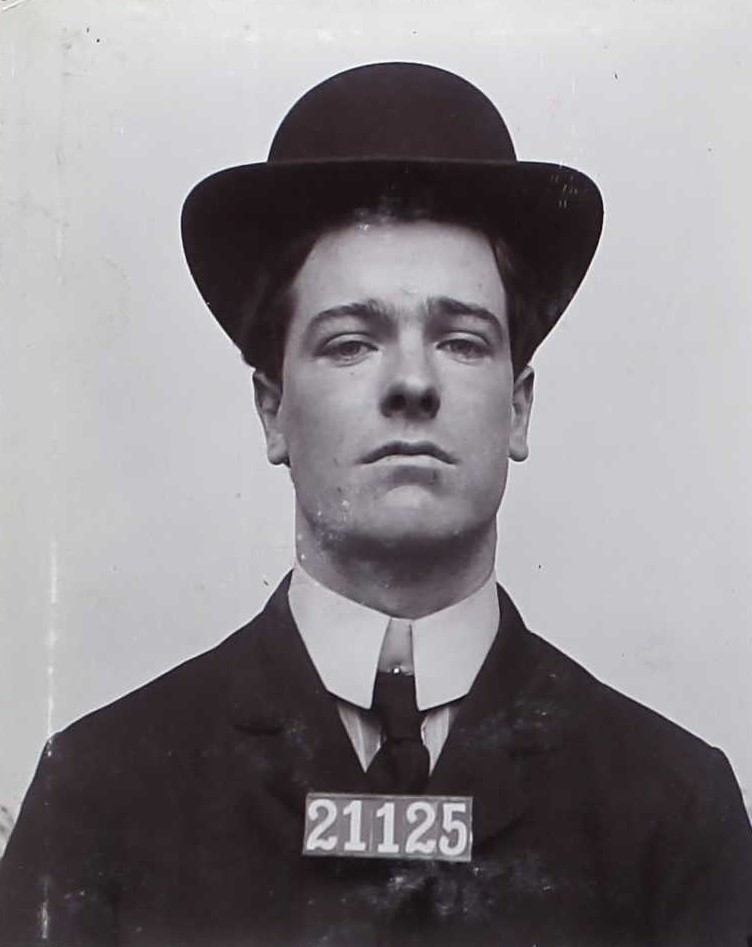
And after he was processed:
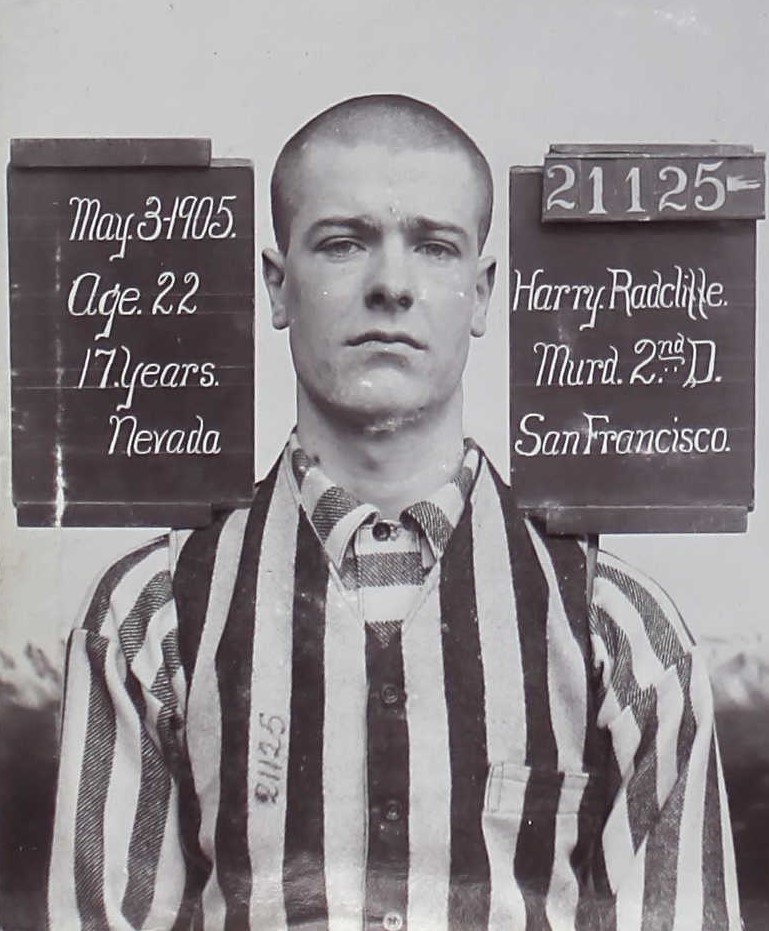
According to the 1910 U.S. federal census, Harry was working as a pastry cook in the officer’s mess hall at San Quentin.
Harry was paroled on October 11, 1911. He was pardoned November 11, 1913 and he was released from parole on December 3, 1915.
So what happened to Harry and Marion? At some point they divorced sometime after Harry was released from prison. They both remarried.
In the 1940 U.S. federal census, Harry is living in San Francisco on Monroe Street, unmarried and working as cook’s helper at a restaurant. The census also states that Harry was living in Sacramento, California in 1935.
Harry Richard Radcliffe died on December 24, 1945 in San Francisco and was apparently of the Catholic faith, is buried in an unmarked grave in Holy Cross Catholic Cemetery in Colma, California. This is also the where that Andrew Riley was laid to rest 300 yards away, 41 years earlier. The ironic twist being that murderer and victim are buried three football fields apart.
Special thanks to Tom Brocher, dedicated FindaGrave volunteer. Your contributions help all researchers, historians, genealogists and, most importantly, families immensely.
If you are enjoying our blog, please subscribe and/or comment below! Thank you visiting us! We are so grateful for your interest!
June 9, 2023


Check out our archives to read all our posts!
- October 2025
- July 2024
- June 2024
- February 2024
- January 2024
- December 2023
- November 2023
- June 2023
- May 2023
- April 2023
- March 2023
- February 2023